JeriCommerce makes it easy to add a link to download the wallet pass from email campaigns, marketing SMS, or the admin area of your shop.
Below you'll find how to create dynamic links based on the customer's email, or a simpler link for unregistered customers that makes signing up for your program easier.
In these examples, variables inside double curly braces {{variable}} need to be replaced with your actual values (including the braces).
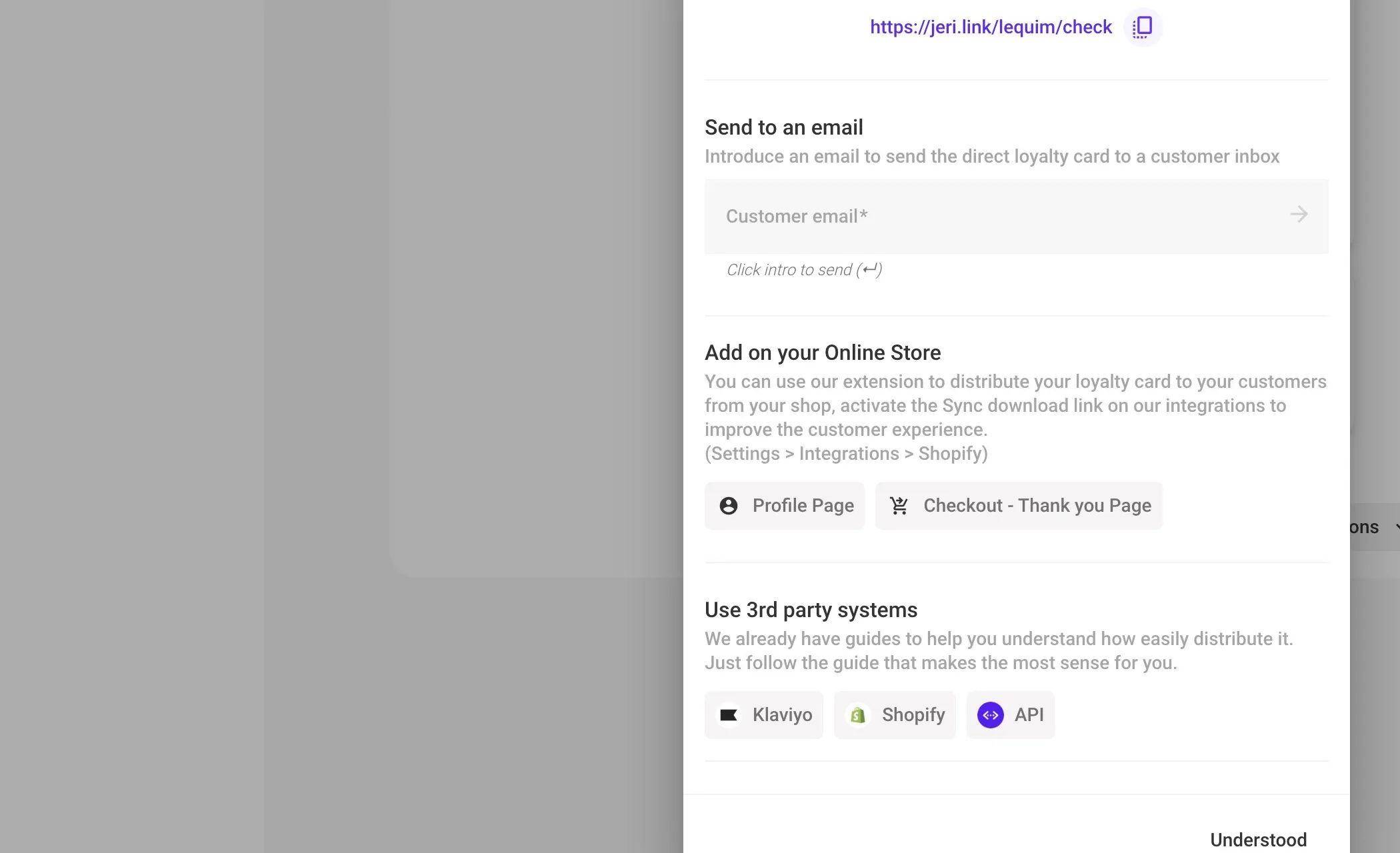
One of these variables is the program slug. In Customize → Loyalty card, click Learn how to distribute it and copy the part after jeri.link/ in the public URL. For example, the URL https://jeri.link/lequim/check uses lequim as its program slug.
New Customers 
You may or may not already know the customer's email, so there are two types of links:
Unknown Customer Email 
Use this generic URL for public campaigns or to print on a QR code for your physical store.
https://jeri.link/{{program_slug}}/check
Known Customer Email 
This link is useful for email promotions when you already know the customer's email. Adding it as a query parameter pre-fills the email field in the signup process.
https://jeri.link/{{program_slug}}/check?email={customer_email}
Registered Customers 
Request Loyalty Card Link 
When you send an email to a customer who's already in your loyalty program, you can include a direct link for them to request the loyalty card.
https://jeri.link/{{program_slug}}/send-pass?email={customer_email}
Send Email with Direct Download Link 
This is the best way to distribute your loyalty card. This feature, called "Download link", is available as a Shopify meta field integration, a Shopify Flows action, a Klaviyo profile attribute, or through the API. See the details in our download links guide.
Checkout Extension 
You can also distribute the loyalty card through the checkout extension — right on the order confirmation page.
See the checkout extension use case.
Add UTM sources as query parameters to your links to track where customers install the loyalty card. We send these UTM parameters to all event integrations and store them in analytics so you can analyze where installs come from.