For programs with periodic tier cycles (yearly, enrollment-based, or calendar-based), JeriCommerce performs an automatic recalculation process. Recalculation is a scheduled review that evaluates customer tier status based on their activity during the cycle period and resets the tracking for the next cycle. This ensures customers maintain appropriate tier levels based on recent activity.
When Does Recalculation Happen?
Recalculation occurs on each customer's specific recalculation date, which is set based on your loyalty program's cycle type configuration:
- Enrollment-Based: The recalculation occurs one year from when the customer joined your program.
- Calendar-Based: Recalculation happens at the end of each calendar year.
- Lifetime: Tiers never reset automatically.
- None: Tiers never reset automatically (same as "Lifetime").
The system runs a daily job to process all customers whose recalculation date is today.
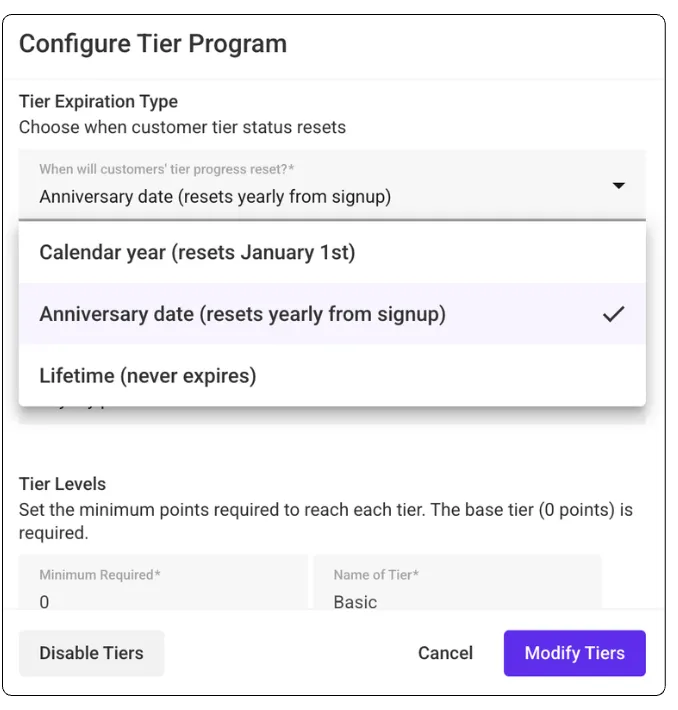 JeriCommerce > Settings > Loyalty > Tiers > Edit
Understanding the Recalculation Process
Recalculation determines if a customer maintains or changes their status for the upcoming year by using the points accumulated during the previous cycle (Carry Tier Points).
Recalculation Steps
- Points Are Locked In: The customer's official tier points (Current Tier Points) become the value of their Carry Tier Points from the previous cycle.
- Carry Points Reset: The Carry Points then reset to 0, ready for the new cycle.
- Tier Status Check: The system checks if the new Current Tier Points (copied from Carry) still qualify the customer for their previous tier. The customer is placed in the highest tier for which they qualify.
- Tier Change/Notification: If the tier status changes (up or down), a notification is sent. If the tier is maintained, no notification is sent.
- Reset for Next Cycle: A new recalculation date is set for the following year.
| Status | Before Recalculation (End of Year 1) | After Recalculation (Start of Year 2) |
|---|---|---|
| Current Tier | Gold | Silver (Downgraded) |
| Current Tier Points | 8,000 | 3,000 (Copied from Carry) |
| Carry Tier Points | 3,000 | 0 (Starting fresh) |
- Scenario: Mike was Gold before the review (needs 5,000 points). His Carry Points were 3,000.
- Result: With only 3,000 locked-in points, he now qualifies only for Silver (needs 1,000 points).
- Notification: The tier changes from Gold to Silver, and a notification is sent.